Wealth Migration
The Monaco-Miami Corridor
Miami is no longer a winter escape. It's a second operational base

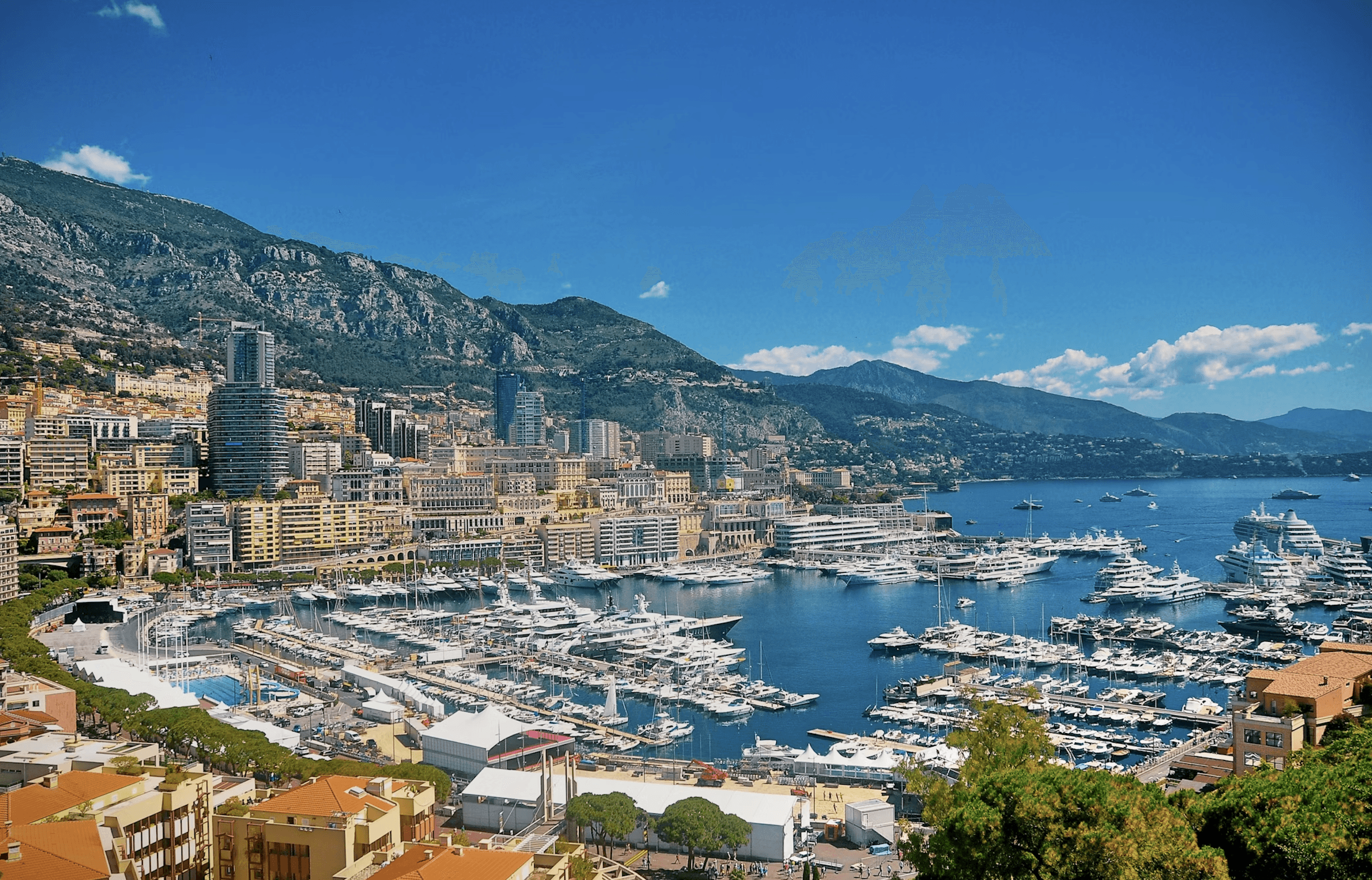
Transatlantic residence patterns of European UHNWIs have changed over the past five years in ways conventional wealth advisory has been slow to map. Monaco retains its position as the established European anchor for principals prioritising fiscal stability and historical continuity. The principality holds zero personal income tax for residents who are not French nationals. Its private banking infrastructure is mature. What has changed is what sits on the other side of the corridor. Miami has moved from winter escape to second base of operations for a growing share of European principals. The transatlantic rhythm no longer treats the Atlantic as a vacation gap.
Data underlying this shift is consistent. Knight Frank’s Wealth Report 2026 identifies the Ultra-Mobile owner archetype as one of the dominant lifestyle profiles in the current UHNWI population: a principal spending fewer than 90 days per year in any single residence, whose property portfolio is structured around continuous base-hopping rather than primary residence, and whose advisory needs require coordination across three to five jurisdictions simultaneously (Knight Frank, 2026). Miami prime residential prices appreciated 80 percent in the five years to mid-2025. The city now sits among the four strongest global prime markets alongside Tokyo (plus 120 percent), Dubai (plus 107 percent), and Seoul (plus 81 percent) (Knight Frank, 2026). Miami is no longer pricing for seasonal demand. It is pricing for base-of-operations demand.
Principals reshaping this corridor are not a homogeneous group. The earliest movers were Italian and French principals establishing Miami beachhead operations between 2010 and 2015, often via family office vehicles structured through Luxembourg or Delaware holding companies. The second wave, from approximately 2018, came from Swiss principals and broader European wealth seeking dollar-denominated exposure as a hedge against euro and pound volatility. The third wave, from 2022 onward, has come from post-Brexit UK principals, post-non-dom UK relocators, and the broader category of European HNWIs facing fiscal tightening at home and seeking jurisdictional optionality (Henley and Partners, 2025).
The lifestyle rhythm is textured. The pattern emerging in advisory practice resembles: Paris or London in spring (March to May), Mediterranean (Cote d’Azur, Sardinia, the Greek islands) in summer (June to August), Aspen or Saint-Moritz in winter (December to February), and Miami across shoulder seasons (September to November and March to April). Miami months are not vacation. They function as the North American base for European principals, with private banking, Latin American business interactions, and family office coordination concentrated during these windows. Brickell and Edgewater capture the business-anchored profile. Coconut Grove, Pinecrest, and Coral Gables capture the family-anchored profile. Surfside and Bal Harbour remain the beachfront-anchored profile, increasingly through branded residences (Four Seasons, St. Regis, Ritz-Carlton).
The Italian flat-tax regime has indirectly accelerated this corridor. Principals moving from London to Italy for fiscal optimisation in 2024 and 2025 frequently retain US business exposure previously coordinated through London. Miami becomes the natural North American coordination base, complementing Milan or Rome rather than competing with them. Swiss principals have built Miami exposure as the dollar-denominated complement to their CHF-anchored European base. Knight Frank’s Wealth Report 2026 identifies this pattern: the UHNWI archetype now constructs residence as portfolio architecture, with each base serving a specific operational function (Knight Frank, 2026).
Private aviation infrastructure has matured to support this rhythm. American HNWIs subscribing to European private aviation programmes through VistaJet, NetJets Europe, and similar carriers have grown materially since 2023, with VistaJet specifically reporting strong North American growth in transatlantic Program traffic (VistaJet, 2024). The reverse flow (European principals using American private aviation for Atlantic coordination) has grown in parallel. Transatlantic crossing frequency for the Ultra-Mobile cohort has increased from two to three crossings per year (typical of 2015) to six to ten crossings per year (typical of 2025). This frequency makes a European-based aviation membership operationally essential for principals whose primary residence is European but whose North American activity is substantial.
Implications for service providers are direct. Real estate brokerages structured around purely local markets are losing share at the top of the market. Family offices increasingly request advisors who can discuss French succession planning, Italian flat-tax structuring, and Florida domicile in the same conversation. The Barnes-Compass partnership, structured in 2023 to bridge European and American luxury markets, is one explicit attempt to build cross-border architecture at scale. Effectiveness of any such network depends on depth, not branding ambition. Yachting brokerages serving the corridor face parallel pressure. Clients want a single advisor across regions, not a referral handoff.
Brooke Harrington’s analysis of wealth management captures the underlying transformation. The principal at the UHNWI level no longer interacts with separate advisors in separate jurisdictions. The principal retains a coordinator (usually a private client lawyer, a family office director, or a senior wealth manager) who orchestrates the advisory network across the principal’s full footprint (Harrington, 2016). The Monaco-Miami corridor is the geographic manifestation of this coordinated architecture: two anchors connected by continuous transactional and advisory flow.
Caroline Knowles’ framework for understanding super-rich social infrastructure adds another dimension. Knowles documents how the very wealthy maintain identity and social standing through their physical movement between specific clubs, residences, and social spaces, with each location carrying particular reputational weight (Knowles, 2022). Monaco’s social calendar (the Yacht Show in September, the Grand Prix in May) anchors the European reputational base. Miami’s social infrastructure (Art Basel in December, the polo season in early winter, the renovated Surf Club and Faena culture) anchors the American reputational base. The principal moving between them is not optimising tax alone. The principal is constructing a transatlantic social identity supporting the family’s positioning over multiple decades.
This shift is real and lasting, not cyclical. European principals reshaping the Monaco-Miami corridor are building habits and infrastructure that will outlast specific tax regimes. Italian flat-tax adjustments, US political volatility, and UK fiscal reforms will continue to shift the marginal advantages of each base. The corridor itself has matured to the point where it functions independently of any single jurisdiction’s policy choices. Advisors, brokerages, and family office structures positioned across the corridor in 2025 will define the next decade of UHNWI transatlantic advisory.
References
Atkinson, R., Burrows, R., and Rhodes, D. (2016) ’Capital City? London’s Housing Markets and the Super-Rich’, in I. Hay and J.V. Beaverstock (eds.) Handbook on Wealth and the Super-Rich. Cheltenham: Edward Elgar Publishing, pp. 225-243.
Harrington, B. (2016) Capital Without Borders: Wealth Managers and the One Percent. Cambridge, MA: Harvard University Press.
Hay, I. and Beaverstock, J.V. (eds.) (2016) Handbook on Wealth and the Super-Rich. Cheltenham: Edward Elgar Publishing. ISBN 978-1-78347-403-5.
Henley and Partners (2025) Henley Private Wealth Migration Report 2025. London: Henley and Partners and New World Wealth, June 2025.
Italian Ministry of Finance (2024) Decreto-Legge n. 113 del 9 agosto 2024 (Decreto Omnibus). Gazzetta Ufficiale, 10 August 2024.
Knight Frank (2026) The Wealth Report 2026. London: Knight Frank Research.
Knowles, C. (2022) Serious Money: Walking Plutocratic London. London: Allen Lane (Penguin).
McKenzie, R. and Atkinson, R. (2020) ’Anchoring capital in place: The grounded impact of international wealth chains on housing markets in London’, Urban Studies, 57(1), pp. 21-38.
Paris, C. (2016) ’The Residential Spaces of the Super-Rich’, in I. Hay and J.V. Beaverstock (eds.) Handbook on Wealth and the Super-Rich. Cheltenham: Edward Elgar Publishing, Chapter 12, pp. 244-263.
VistaJet (2024) Annual Report and Market Update 2024. London: Vista Global Holdings.